
The Party Killing and the False Alibi
Hallowe'en PartyThis thread examines how Joyce is killed amid party games, how the physical evidence is obscured, and how Poirot turns a theatrical mishap into a route to the murderer.
increasing Bearing strength in each event
 decreasing
Bearing strength in each eventdecreasingAn Elaborate Children’s Party
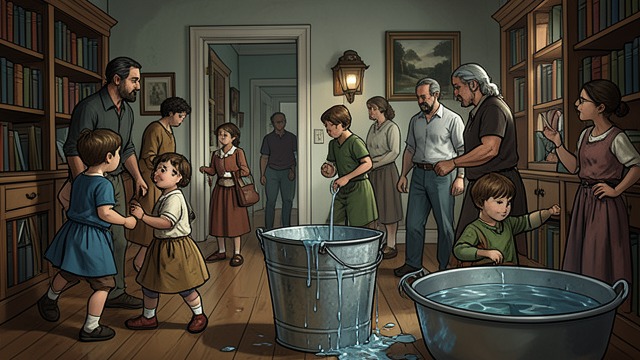
An Elaborate Children’s Party
Carefully Managed Festivities
Rowena Drake organizes a busy Halloween party at Apple Trees, arranging contests, mirrors, dancing, supper, and the final Snapdragon. The household is crowded with children, parents, helpers, and guests moving between rooms.
The apple-bobbing game takes place in the library, where a sturdy galvanised bucket is chosen over a lighter plastic pail. Water is expected to spill, so damp clothing and disorder will not automatically draw attention.
A Body in the Library
After the party ends, Joyce cannot be found. The adults search the house and discover her in the library, drowned with her head forced into the water-filled tub.
The celebration’s many rooms, moving guests, and noisy finale create opportunities for someone to act unseen. They also make it difficult to establish exactly when Joyce died or who left the crowded group long enough to kill her.
A Murder in the Dark
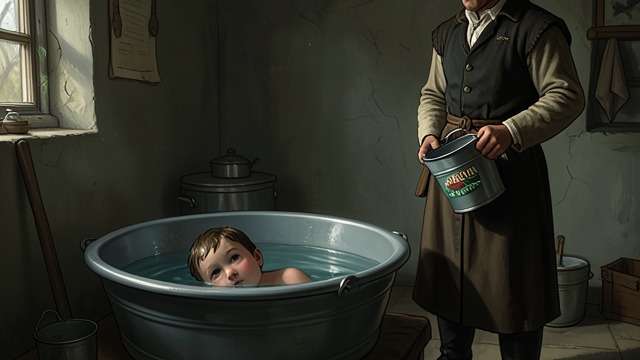
A Murder in the Dark
A Brief Opportunity
As the guests gather for the burning raisins of the Snapdragon, attention shifts away from the rest of the house. The dining room’s flames, cries, and crowd offer a noisy cover for movement through the hall.
Joyce is taken to the library, where the apple-bobbing equipment is still present. The apparent familiarity of the room and the activity lets the murderer approach without making the child immediately suspicious.
Force Hidden by Festivity
Joyce is held underwater until she dies. The method is direct but leaves a practical problem: a struggle in a full bucket is likely to splash the killer.
The party’s general disorder may conceal the wet clothes, yet Poirot recognizes that the killer still needs an explanation that will survive scrutiny. The murder’s physical mechanics therefore generate the clue that eventually exposes its staging.
The Broken Vase
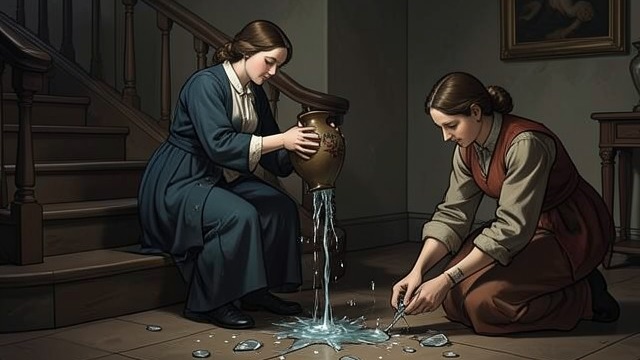
The Broken Vase
A Witness on the Landing
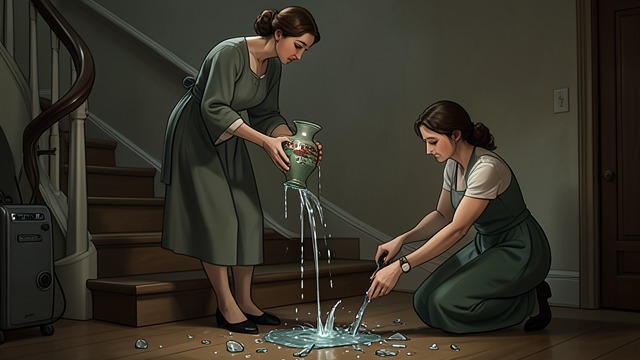
Elizabeth Whittaker leaves the hot Snapdragon room and sees Rowena Drake on the stairs holding a heavy vase. Rowena appears to be looking toward the library door when she suddenly drops the vase and spills its water over herself.
Whittaker helps her clear the broken glass as the party disperses. Rowena presents the event as a tiring mistake, and the mess offers a credible reason for her wet clothes at precisely the point when the killer’s clothing might otherwise invite suspicion.
A Clue in the Performance
Whittaker does not see anyone come out of the library, but she believes Rowena reacted to something there. Her memory gives Poirot a witness to both the apparent accident and Rowena’s unusual start.
The vase is more than a convenient source of water. By staging the break, Rowena creates a visible explanation that can disguise where the wetness came from and misdirect attention toward an unidentified figure near the crime scene.
A Guilty Woman’s Denial
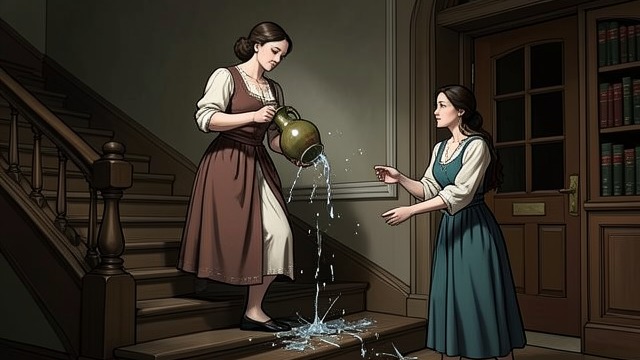
A Guilty Woman’s Denial
The Hostess’s Account
Poirot asks Rowena about Whittaker’s recollection and the vase. Rowena confirms that she dropped it but denies that she saw anyone leave the library or that anything startled her.
Her composure makes the denial more revealing than a visible panic would have been. Poirot suspects that she is withholding the identity of someone she saw, perhaps because she believes that person to be young or not fully responsible.
A Misread Sighting
After Leopold is found dead, Rowena returns to Poirot and admits that Leopold was the figure she saw near the library. She had kept silent because she assumed he had killed Joyce and wanted to protect him from harsh punishment.
Her interpretation was wrong: Poirot believes Leopold found Joyce’s body or encountered evidence of the actual killer. Rowena’s silence allowed the truth to remain obscured and left the boy vulnerable to the person who feared his knowledge.
Water Reveals the Killer
Water Reveals the Killer
An Alibi Built from a Spill
Poirot explains that Joyce’s killer must have become wet while forcing her head beneath the water. Rowena’s vase supplied a ready-made explanation and a witness who could verify that she had been soaked at the end of the party.
Whittaker’s observation gives Poirot the missing connection between the library and the landing. Rowena’s supposed clumsiness was not an unrelated mishap but a carefully arranged piece of evidence management.
The Method Exposes the Deception
The same water that killed Joyce also undermines the killer’s attempt to hide. Poirot reconstructs how Rowena created the accident, drew attention to the broken vase, and encouraged Whittaker to believe she had glimpsed someone leaving the library.
The detail matters because it turns a crowded party’s apparent confusion into a coherent sequence. Rather than relying on a confession or an accidental discovery, Poirot reads the practical needs of the murder and the false explanation designed to meet them.
The afternoon and evening of Halloween
During the Snapdragon at the end of the party
At the party’s closing moments, just before the guests leave
During Poirot’s first interviews at Apple Trees
During Poirot’s final explanation to Ariadne Oliver
